



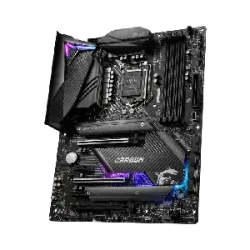
The motherboards category covers desktop boards for AMD and Intel processors, server and workstation boards, and laptop and OEM boards. Our range holds over 7,000 products from brands such as LENOVO, GIGABYTE, ASRock, ASUS and MSI. It suits anyone building a new PC as well as those repairing or upgrading an existing one.
How to choose a motherboard
Processor socket. The board must match the processor socket, otherwise the CPU will not fit. In our range you will find AM5 and AM4 boards for AMD processors, plus Intel LGA1851, LGA1700 and older Intel boards (LGA1200 and earlier). Even with the same socket, some processor generations need a newer BIOS version, so check the manufacturer's CPU support list before buying.
Memory type. AM5 and LGA1851 boards are built for DDR5 memory, while AM4 boards use DDR4. LGA1700 boards come in both DDR4 and DDR5 versions, and the two module types cannot be swapped. It is also worth checking the number of memory slots and the maximum capacity and speed the board supports.
Form factor. ATX, micro-ATX and mini-ITX boards differ in size, so the format must match your case. ATX boards usually offer more PCIe slots and M.2 connectors, whereas mini-ITX suits a small case but has fewer expansion options.
Chipset and connectivity. The chipset determines how many M.2 slots and USB ports the board has and whether you can overclock the processor. If you plan to use fast NVMe drives, check the number of M.2 slots and the PCIe version. Built-in Wi-Fi and a faster network port are more often found on higher-end boards.
Laptop, OEM and server boards. Laptop and OEM boards are not universal, so choose them by the exact device model or part number. Server and workstation boards often use ECC memory and offer remote management, and some support two processors.
Brands we carry
- LENOVO: accounts for the largest part of our range, mainly laptop and OEM boards for repairing specific Lenovo devices.
- GIGABYTE: makes desktop boards for AMD and Intel processors, with gaming models often sold under the AORUS name.
- ASRock: offers boards for both AMD and Intel platforms and is also known for industrial and server boards.
- ASUS: known for the ROG and TUF Gaming gaming lines, as well as the ProArt series for content creators.
- MSI: makes desktop boards, with the MAG, MPG and MEG series aimed at different budgets.
- SUPERMICRO: specialises in server and workstation motherboards.
Also in our range: BIOSTAR, HP INC., HP Enterprise, ICY DOCK, SAPPHIRE and KONTRON.
Subcategories include AM5 boards, AM4 boards, Intel LGA1851 and LGA1700 boards, older Intel boards, server and workstation boards, and laptop and OEM boards.
Frequently asked questions
How do I know which motherboard fits my processor?
Start by matching the processor socket to the board socket, for example AM5 or LGA1700. Then open the CPU support list for the specific board on the manufacturer's website and check whether your processor needs a newer BIOS version.
Can I use DDR4 memory on a DDR5 motherboard?
No, DDR4 and DDR5 modules have different connectors and do not physically fit each other's slots. The board decides the memory type: AM5 and LGA1851 use DDR5, AM4 uses DDR4, and LGA1700 boards come in both versions.
What is the difference between ATX, micro-ATX and mini-ITX boards?
They differ in size and expansion options. ATX is the largest and has the most slots, micro-ATX is smaller with fewer expansion slots, and mini-ITX is the smallest and usually has a single PCIe slot. Choose the format your case supports.
Is an AM4 motherboard still worth buying?
An AM4 board makes sense if you already own DDR4 memory and an AM4 processor, or want to build a PC around DDR4. Newer processor generations and DDR5 memory need an AM5 board, and you cannot carry the processor and memory over from AM4 to it.


