



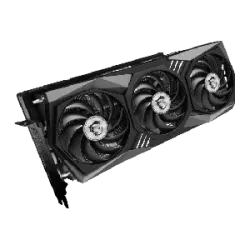
This category contains graphics cards for gaming, 3D rendering, video editing, AI workloads and multi-monitor desks. Our range includes over 600 models built around NVIDIA and AMD graphics processors, plus a few Matrox and Intel options. GIGABYTE, PNY, ASUS and ZOTAC account for the most models.
How to choose a graphics card
Graphics processor. Most cards in our range use NVIDIA GeForce chips, though there are AMD Radeon models too. Buyers often pick NVIDIA for ray tracing and DLSS, while AMD is worth comparing on gaming performance. Check benchmarks for the specific model with the games or software you actually use.
Video memory. Both the amount and the type matter. Our range includes GDDR6 and newer GDDR7 cards, while GDDR5 and older memory appears on only a few models. For Full HD gaming 8 GB is enough in many cases, and higher resolutions or AI models call for more.
Size and power. Many cards are full-height and full-length (FH/FL), but there are also shorter FH/HL and low-profile HH/HL models for small cases. Measure the free length and thickness in your case, then check the card specification for the recommended power supply and any extra power connectors it needs.
Display outputs. Many cards offer three DisplayPort outputs and one HDMI, while some have two HDMI or none at all. DVI-I is now rare, so an older monitor may need an adapter. For many models the maximum resolution reaches 7680 x 4320 pixels, but in practice your monitor and cable set the limit.
Graphics card brands
- GIGABYTE: makes both NVIDIA and AMD cards, known for WINDFORCE cooling and the AORUS range.
- ASUS: known for its ROG and TUF Gaming series aimed at gamers.
- PNY: an NVIDIA partner that also makes professional RTX cards for workstations.
- ZOTAC: builds NVIDIA GeForce cards, including shorter models for small cases.
- NVIDIA and AMD: the designers of the graphics processors, who also sell their own reference models.
- XFX, Sapphire and PowerColor: specialise in AMD Radeon cards.
- INNO3D: makes NVIDIA GeForce cards and is known for its iChill series.
- ASRock: offers Radeon cards in its Phantom Gaming series.
Also in our range: BIOSTAR graphics cards.
Frequently asked questions
How much video memory do I need for gaming?
For Full HD gaming 8 GB is enough in many cases, while 1440p or 4K is better served by 12 GB or more. Recent games with high-quality textures use more memory than older ones. AI models need even more video memory.
What is the difference between GDDR6 and GDDR7?
GDDR7 is the newer generation of video memory and transfers data faster than GDDR6. In our range GDDR7 appears on the latest cards, while GDDR6 is found on many older models too. The graphics processor itself still decides overall performance, so memory type should not be judged on its own.
Should I buy an NVIDIA or an AMD graphics card?
It depends on how you use the card. NVIDIA GeForce is often chosen for ray tracing, DLSS and broad software support in creative applications. AMD Radeon cards are worth comparing on gaming performance, so look at benchmarks for the specific models you are considering.
How do I know if a graphics card will fit my case?
Compare the card length, thickness and height with the free space listed by your case manufacturer. Many cards occupy two or more expansion slots, and shorter models are found among FH/HL and HH/HL formats. Also check that your power supply has the extra power connectors the card needs.


